Overview
The focus of the Trip Interview Program (TIP) is to collect detailed commercial fisheries information at the individual trip level. The catch, effort, and biological data collected by trained biologists is a major component of the Atlantic Coastal Cooperative Statistics Program in the Southeastern Atlantic coastal region and the commercial Fisheries Information Network in the Gulf of Mexico coastal region. The TIP is a long standing data set developed in the 1980’s as part of the State-Federal Cooperative Statistics Program.
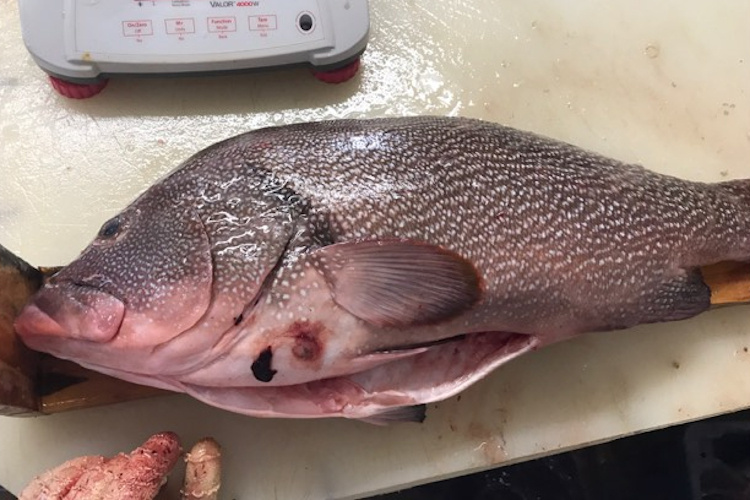
![WD_Speckledhind.jpg]()
Speckled Hind on measuring board.
How is data collected?
TIP data is collected by shore-based samplers located in coastal areas in the South Atlantic and Gulf of Mexico. These trained field biologists visit docks and fish houses to interview fishermen and take length, weight, and biological samples from their catch. These samples, which include otoliths, spines, and occasional tissue samples, are sent to one of two laboratories for biologists to analyze and determine the fish’s age and other biological information.
Interviewing fishermen directly allows samplers to obtain first hand detailed information on the fishing effort for the trip in addition to the biological information obtained from the catch. In most cases, these interviews happen upon the initial offload of the catch to the fish house, at other times, interviews may take place over the phone, after the initial offload.
![WD_Redsnapperyellowedgegroupertilefish.jpg]()
Snapper, grouper and tilefish otoliths.
Why is data collected?
The ability to estimate the age distribution of fish within a given population and how that distribution changes over time is crucial for population assessments. This information in conjunction with length, at age, and maturity stage help to form an overall picture of the health of the population (stock) and aid in the assessment process. The age of the fish, determined by the aging laboratories, in addition to the length of the fish, are used to determine the age-at-length for a sample of the population. This data is then used to estimate the age distribution for the entire stock.
In addition to collecting biological data, the Program serves as a quality assurance on catch and effort data. It validates the species composition of the landings as well as the type and quantity of gear through first hand, trained observation.
More Information
TIPS Data Entry Program (requires login)
Contact
Lawrence Beerkircher

 An oceanic whitetip shark swims near the surface of the water. Photo courtesy of John Carlson.

 Homeported in Pascagoula, Mississippi, NOAA Ship Pisces is the third in a class of state-of-the-art, acoustically quiet fisheries survey vessels built for a wide range of living marine resource surveys and ecosystem research projects. The ship focuses primarily on U.S. waters from the Gulf of Mexico, Caribbean, and South Atlantic to North Carolina. Credit: NOAA
 Recreational angler holding red snapper. Credit: Fish and Wildlife Research Institute.